

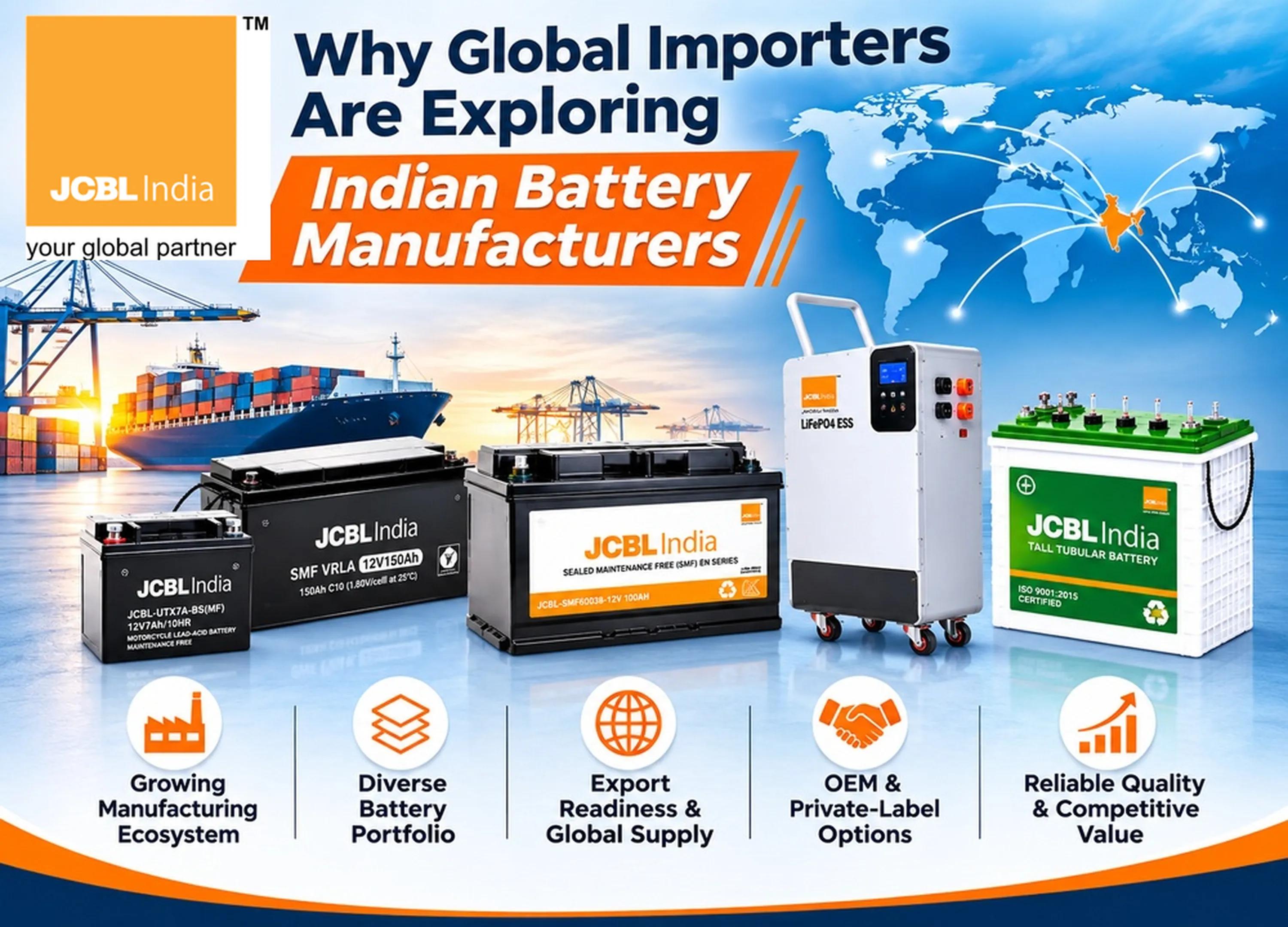
Global battery demand is creating new sourcing opportunities across automotive, industrial, renewable energy, and backup power sectors. As importers and distributors review their supplier networks, India is becoming a destination worth evaluating for a diverse range of battery products.
Indian suppliers serve applications ranging from automotive starting and motorcycle batteries to industrial backup systems and lithium-ion energy storage. For international buyers, choosing a supplier involves more than comparing prices. Product quality, technical specifications, manufacturing capabilities, export readiness, and long-term supply support all influence the decision.
Companies such as JCBL India Batteries are part of this developing supply landscape, offering multiple battery categories for importers, wholesalers, distributors, and OEMs.
Why Are Global Importers Considering India for Battery Sourcing?
International buyers increasingly evaluate suppliers across different regions to diversify procurement and improve supply-chain flexibility. India offers opportunities through its developing battery manufacturing ecosystem, diverse product categories, and export participation.
1. Diverse Battery Product Options
Different industries require different battery technologies. Automotive businesses need starting batteries suited to specific vehicle requirements, while industrial customers may need backup solutions. Solar and residential energy storage applications can require different battery chemistries and configurations.
Indian suppliers serving these categories give importers options across multiple market segments.
2. Opportunities to Diversify Suppliers
Working with suppliers across different regions can provide flexibility in procurement planning and help reduce dependence on a limited supplier base. India can form part of a diversified sourcing strategy, provided manufacturers are evaluated on their production capabilities, quality processes, lead times, and export readiness.
3. A Developing Manufacturing Ecosystem
India is working to strengthen domestic battery manufacturing, particularly in the advanced chemistry cell (ACC) segment. The Government of India approved the Production Linked Incentive (PLI) scheme for ACC battery storage with an outlay of ₹18,100 crore and a target of 50 GWh of manufacturing capacity.
According to the Ministry of Heavy Industries' update dated 27 March 2026, 40 GWh had been awarded to four beneficiary firms and 1 GWh had been installed. This indicates that the advanced cell manufacturing ecosystem is developing.
Importers should distinguish between battery cell manufacturing, battery-pack assembly, and finished battery manufacturing when evaluating suppliers, as these are different activities within the value chain.
What Types of Batteries Can Importers Source from India?
Indian battery suppliers serve several established and emerging applications.
Automotive Starting Batteries
Automotive batteries support engine starting and vehicle electrical systems. Importers need products that match vehicle requirements for voltage, capacity, dimensions, terminal layout, and starting performance.
Common technologies include Sealed Maintenance Free (SMF), Dry Charged, Absorbent Glass Mat (AGM), and Enhanced Flooded Battery (EFB).
JCBL India Batteries supplies an automotive starting battery portfolio covering these technologies and referencing BCI, DIN, JIS, and EN standards. Its AGM battery series and EFB battery series cater to different start-stop vehicle requirements.
Importers should check capacity, Cold Cranking Amps (CCA), dimensions, polarity, terminal type, and vehicle compatibility before ordering.
Motorcycle Batteries
Motorcycle and scooter markets require batteries suited to different engine capacities and electrical systems. Distributors may need maintenance-free, gel, or dry-charged options depending on their customers.
JCBL offers a motorcycle starting battery range that includes MF, Gel, and Dry Charged options for different two-wheeler applications.
Industrial and Backup Power Batteries
Industrial facilities, commercial establishments, telecom installations, and homes use batteries for backup power. Product selection depends on the connected load, required backup duration, charging system, and installation environment.
JCBL provides backup application battery solutions, including tubular lead-acid and SMF VRLA batteries. Its tubular solar and inverter batteries serve inverter and solar applications, while its SMF VRLA industrial battery range covers industrial and standby requirements.
Lithium-Ion Battery Solutions
Lithium Iron Phosphate (LiFePO₄) is one of the lithium-ion chemistries used in residential energy storage and backup systems. Buyers should consider voltage, usable capacity, cycle-life information, BMS, safety features, and compatibility with the connected equipment.
JCBL offers a lithium-ion battery portfolio based on LiFePO₄ technology. Its residential energy storage systems include wall-mounted, floor-standing, and rack-mounted configurations.
What Should Importers Look for in an Indian Battery Manufacturer?
A competitive quotation does not establish whether a supplier can meet technical and commercial requirements over time. International buyers should assess the following factors.
1. Manufacturing Capabilities
Understand what the supplier manufactures and which activities are performed by external partners. Distinguish between cell manufacturing, battery-pack assembly, and finished battery manufacturing. Ask about production locations, processes, equipment, inspection stages, and available capacity.
2. Product Quality and Testing
Review product datasheets, testing procedures, quality management systems, and applicable certifications. For automotive batteries, check capacity, CCA, dimensions, and terminal configuration. For industrial and lithium-ion products, evaluate discharge performance, operating limits, safety features, and system compatibility.
3. OEM and Private-Label Options
Some importers want to distribute batteries under their own brand. This may require customized labels, packaging, product specifications, and repeat manufacturing support.
JCBL identifies OEM and private-label battery supply capabilities, including custom branding and packaging. Buyers should confirm minimum order quantities, customization costs, and product-specific arrangements before placing orders.
4. Export Documentation and Logistics
Battery shipments can have specific transport, packaging, labelling, and documentation requirements depending on their chemistry and destination. Buyers should confirm shipping documents, applicable dangerous-goods provisions, packaging standards, and destination-market compliance.
It is also important to calculate landed cost, including freight, insurance, duties, taxes, and handling charges.
5. Communication and Supply Support
Buyers should evaluate how effectively suppliers handle technical enquiries, production updates, order coordination, and product concerns. Warranty terms, inspection arrangements, delivery schedules, and repeat-order responsibilities should be agreed in writing.
JCBL India Batteries: Supporting International Battery Sourcing
JCBL India Batteries is an Indian battery manufacturer, supplier, and exporter backed by the JCBL Group. Its portfolio covers automotive, motorcycle, industrial, backup-power, and lithium-ion battery applications.
The company reports an export presence across Southeast Asia, the Middle East, Africa, Europe, South America, and the USA. Its company profile and export information highlights multiple quality checks, timely deliveries, technology upgrades, and international business relationships.
JCBL also describes research and development capabilities through a centre accredited by the Department of Scientific and Industrial Research (DSIR), Government of India.
For importers and distributors, these details provide a starting point for evaluating the company's product suitability, quality information, and commercial capabilities. Buyers should request current specifications and applicable documentation for the products and markets they intend to serve.
How Global Importers Can Build a Reliable Sourcing Partnership
A structured sourcing process helps buyers compare manufacturers and avoid decisions based only on price.
Identify the application: Determine whether the requirement is for automotive, motorcycle, industrial, backup, or lithium-ion batteries.
Prepare specifications: Confirm voltage, capacity, dimensions, chemistry, and applicable standards.
Evaluate the supplier: Review manufacturing activities, quality processes, certificates, and export experience.
Discuss commercial requirements: Clarify order quantities, packaging, private-label options, pricing, and delivery terms.
Validate products: Review samples or conduct suitable testing before committing to bulk orders.
Agree on responsibilities: Establish quality criteria, warranty terms, communication procedures, and repeat-order arrangements.
Importers preparing an enquiry can also refer to this battery inquiry guide for Indian manufacturers to identify the technical and commercial details they should share with a prospective supplier.
Conclusion
Global importers are exploring Indian battery manufacturers as they assess additional sourcing destinations and product options across automotive, motorcycle, industrial, backup-power, and lithium-ion segments.
India's developing battery ecosystem offers opportunities, but supplier selection still requires careful checks of manufacturing capabilities, specifications, quality documentation, and export readiness.
JCBL India Batteries is one Indian supplier with a portfolio covering these application areas and a stated export presence across several international regions. For importers, wholesalers, distributors, and OEMs, it can be considered as part of a wider supplier evaluation process, with final decisions based on product suitability and commercial requirements.